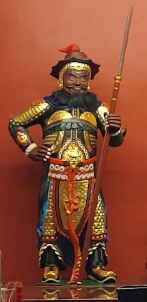
Zhou Cang, styled Yuanfu, is a character in Romance of the Three Kingdoms and is also recorded in the Shanxi Gazetteer. A native of Guanzhong, he once served under Zhang Bao, a leader of the Yellow Turbans, and became an outlaw after their defeat.
When Guan Yu rode alone across a thousand miles to find Liu Bei, he met Zhou Cang through Pei Yuanshao’s introduction. After later learning that Guan Yu and his son had been executed at Mai Castle, Zhou Cang killed himself in loyalty.
In folk belief, he is honored as General Zhou Cang or Grand General Zhou, and is often enshrined to the right of Lord Guan (with Guan Ping on the left). He is typically depicted holding Guan Yu’s Green Dragon Crescent Blade as an attendant deity.
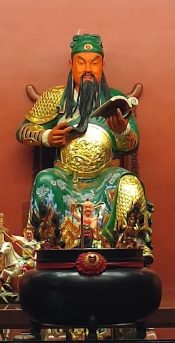
Guan Yu (d. 220), styled Yunchang, was a major general of the late Eastern Han and a key follower of Liu Bei, famed for exceptional loyalty and martial skill. After briefly serving Cao Cao—during which he slew Yan Liang—he rejoined Liu Bei and helped secure territory after Red Cliffs. As governor of Jing Province, he launched the 219 campaign against Fancheng, capturing Yu Jin and killing Pang De, but was eventually defeated by Eastern Wu, captured at Mai Castle, and executed.
Later honored as Marquis Zhuangmou, Guan Yu became a powerful symbol of loyalty and righteousness, gradually deified across East Asia. He is widely known as Lord Guan, Guan Di, or the Martial Sage, and revered in Confucianism, Daoism, and Buddhism. Popular tradition—shaped by Romance of the Three Kingdoms—celebrates him as Liu Bei’s sworn brother and one of the Five Tiger Generals, and he remains a major figure of worship today.
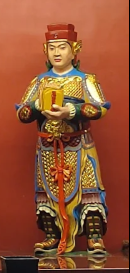
Guan Ping, styled Tanzhi, was born in AD 178. Skilled in archery and riding, he followed his father Guan Yu in battle and was known for bravery and deep filial devotion.
In AD 219, after Guan Yu was trapped by Lü Meng, Guan Ping rushed to save him but was captured, and both were killed on the same day.
He was later honored as Marquis Wuling, King of Utmost Loyalty, and in Daoist tradition as a Celestial Worthy.
Admired for loyalty and filial piety, he is worshipped with Zhou Cang as an attendant deity in temples of Lord Guan—Guan Ping holding the Marquis’s seal, Zhou Cang the Green Dragon Crescent Blade.
History of Sasaran Guan Di Temple (XieTian Temple)
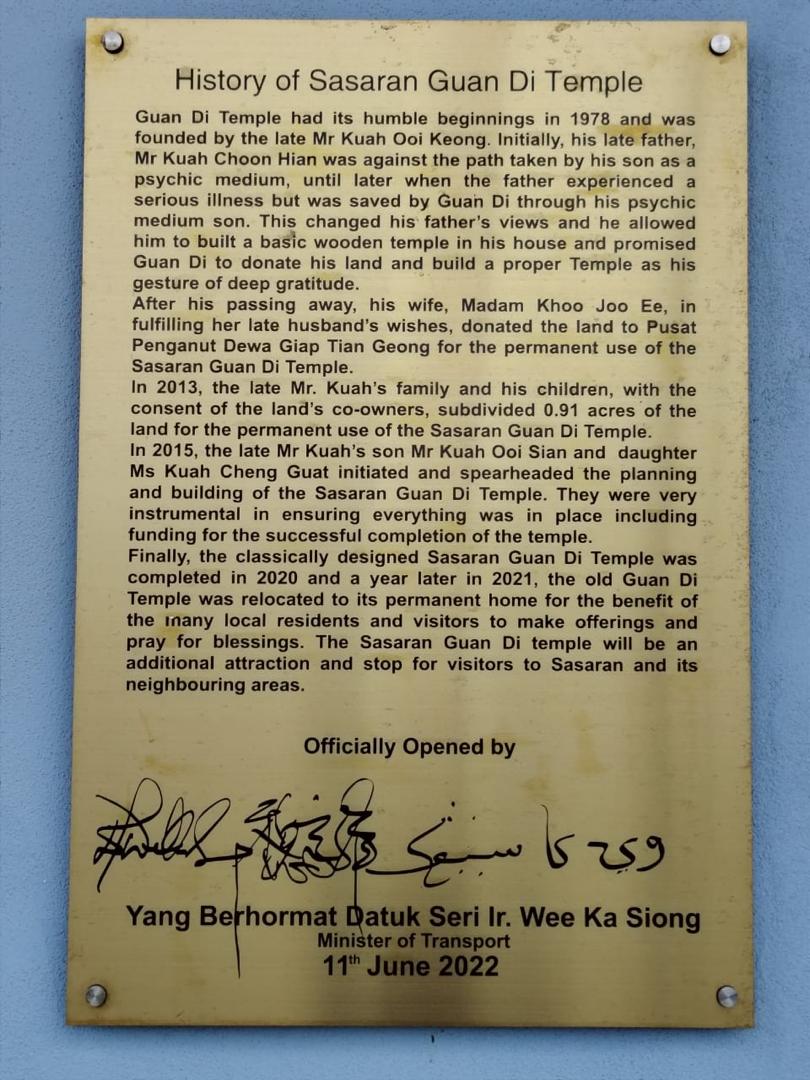
Guan Di Temple had its humble beginnings in 1978 and was founded by the late Mr Kuah Ooi Keong. Initially, his late father, Mr Kuah Choon Hian was against the path taken by his son as a psychic medium, until later when the father experienced a serious illness but was saved by Guan Di through his psychic medium son. This changed his father’s views and he allowed him to built a basic wooden temple in his house and promised Guan Di to donate his land and build a proper Temple as his gesture of deep gratitude.
After his passing away, his wife, Madam Khoo Joo Ee, in fulfilling her late husband’s wishes, donated the land to Pusat Penganut Dewa Giap Tian Geong for the permanent use of the Sasaran Guan Di Temple.
In 2013, the late Mr. Kuah’s family and his children, with the consent of the land’s co-owners, subdivided 0.91 acres of the land for the permanent use of the Sasaran Guan Di Temple.
In 2015, the late Mr Kuah’s son Mr Kuah Ooi Sian and daughter Ms Kuah Cheng Guat initiated and spearheaded the planning and building of the Sasaran Guan Di temple. They were very instrumental in ensuring everything was in place including funding for the successful completion of the temple.
Finally, the classically designed Sasaran Guan Di Temple was completed in 2020 and a year later in 2021, the old Guan Di Temple was relocated to its permanent home for the benefit of the many local residents and visitors to make offerings and pray for blessings. The Sasaran Guan Di temple will be an additional attraction and stop for visitors to Sasaran and its neighbouring areas